

Chlorine vs Saltwater Fiberglass Pool - Quick Guide For Pool Owners [2026]
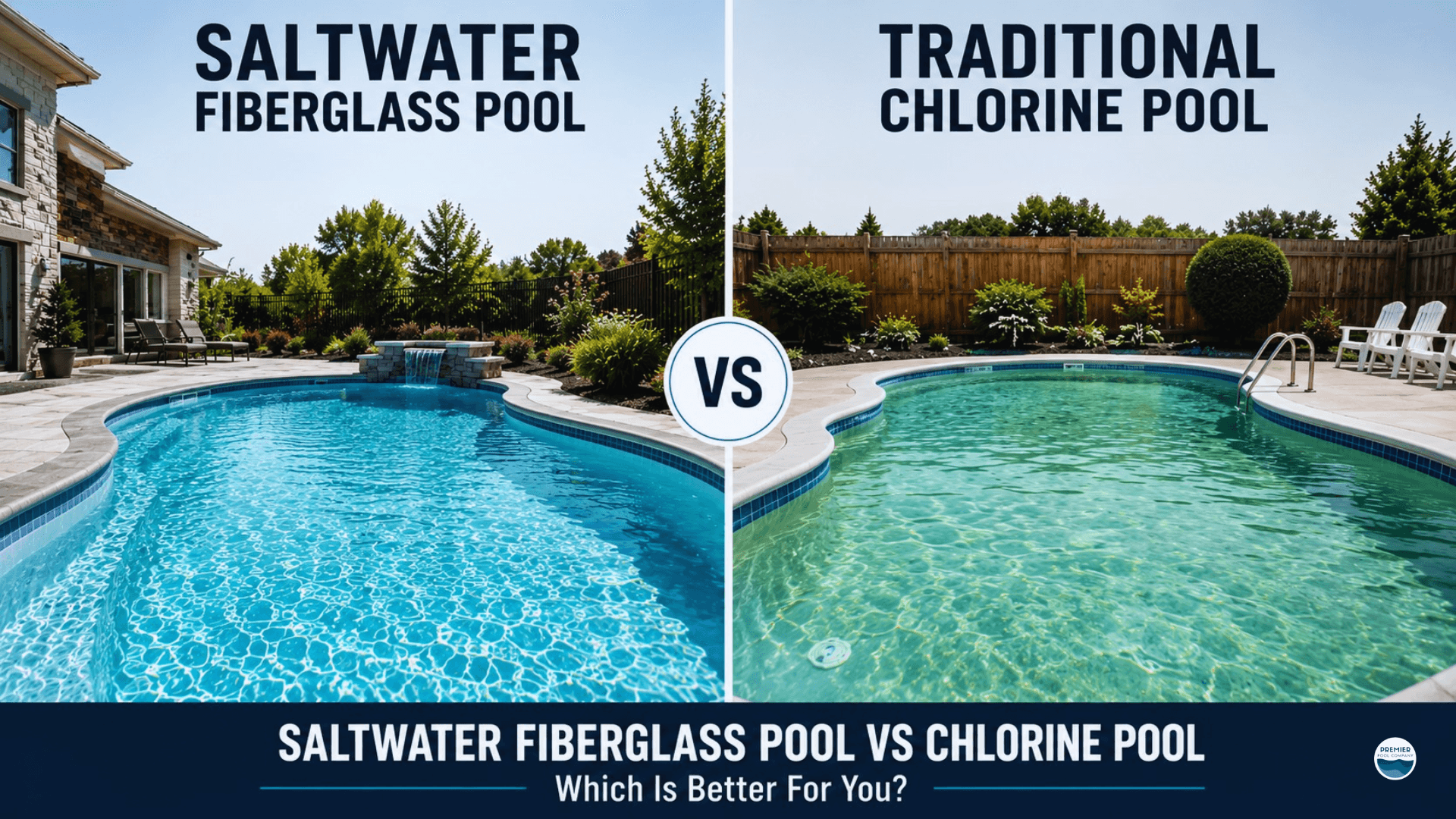
The Question Almost Every Pool Owner Gets Wrong
I’ve worked with tons of pools in the past decade and I’ve noticed that many homeowners don't really understand how water behaves with fiberglass. Many have the wrong idea that having saltwater or normal water with a dose of chlorine are alternatives in terms of luxury.
But in reality, even with saltwater pools, you use chlorine to sanitize the water.
What really differs is the delivery method, the chemistry management burden, the long-term costs, and perhaps most importantly, how each system interacts with the specific material your fiberglass pool is made of. This last point is rarely discussed with the depth it deserves.
Fiberglass pools aren’t simply a neutral vessel that accommodates any water treatment system equally. The gelcoat surface, the structural composite underneath it, and any fittings or hardware embedded in the shell all respond differently to sustained saltwater exposure versus traditionally dosed chlorine water.
Understanding these nuances will save you from expensive surprises and help you make a genuinely informed choice rather than one based on marketing language.
Today, I decided to create this quick guide for pool owners who want real answers and knowledge on the matter.
Whether you're installing a new fiberglass pool and selecting your sanitization system from scratch, or you're considering converting an existing chlorine pool to a saltwater generator, the principles here apply equally.
So let’s begin.
TL;DR - Key Takeaways On Chlorine vs Saltwater Fiberglass Pool
If you're short on time, here's what this guide ultimately establishes:
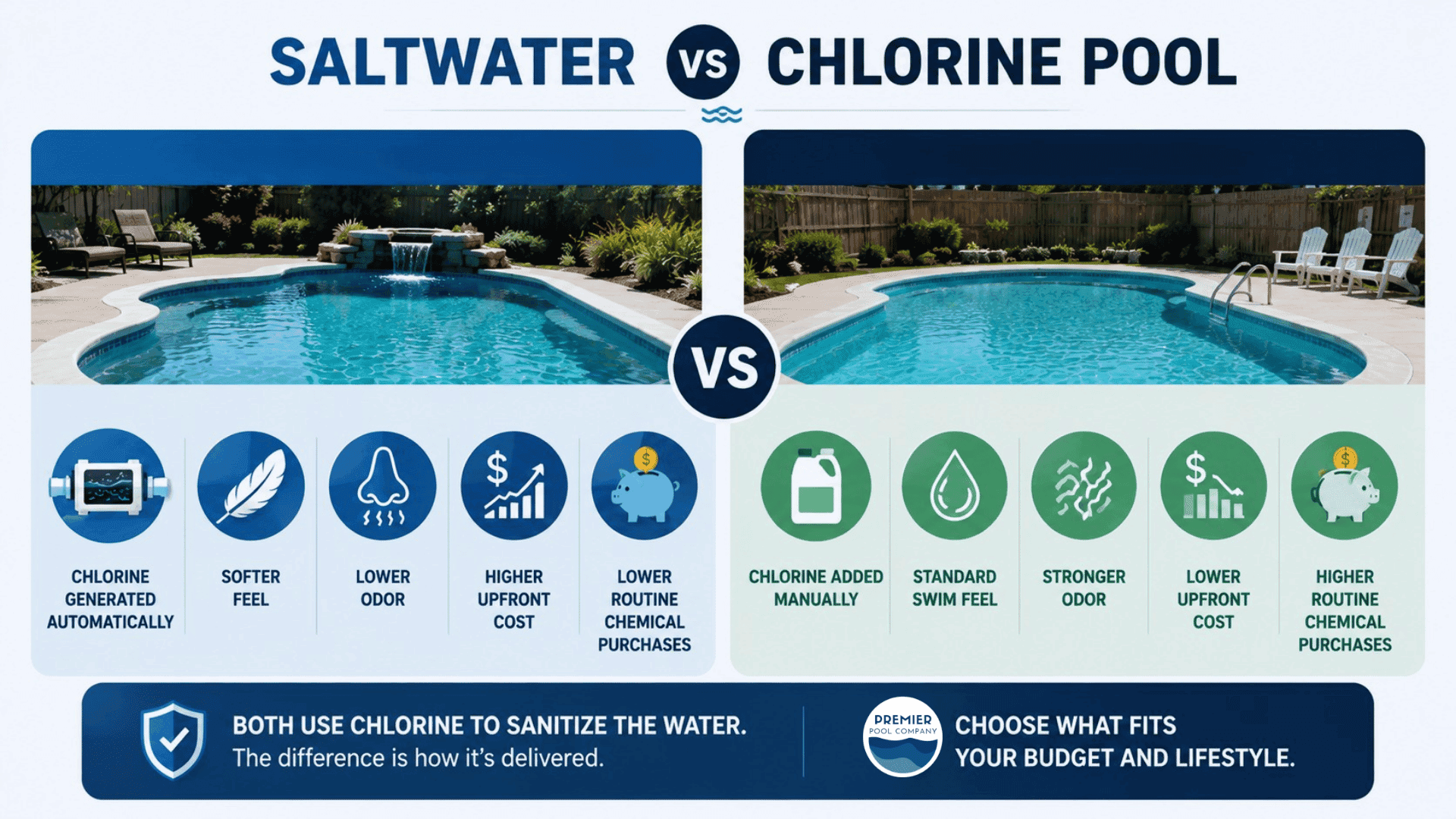
Saltwater pools still use chlorine, but it generates it automatically through electrolysis via a salt cell.
Saltwater is safe for fiberglass shells but it can corrode metal fittings and hardscape.
The softer feel and lower odor in saltwater pools come from reduced chloramines, not an absence of chlorine.
Saltwater systems have higher upfront costs but lower ongoing chemical expenses.
Traditional chlorine pools offer more direct control over water chemistry and are simpler to troubleshoot if anything goes wrong.
The best choice between the two depends on your budget, climate, and maintenance style.
What You're Actually Choosing Between
The Chemistry Is Less Different Than You Think
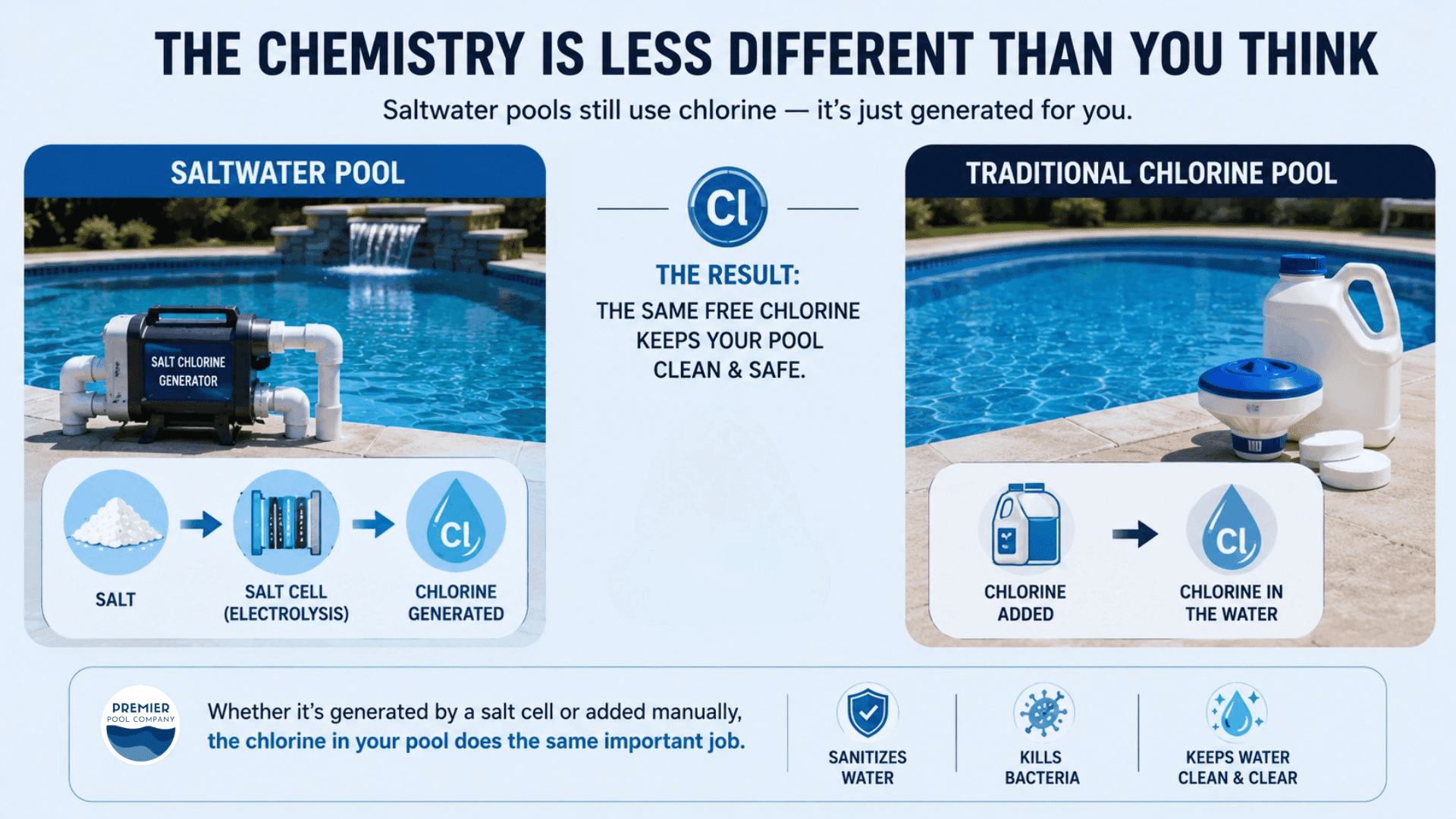
Let's start with the most important clarification: a saltwater pool IS a chlorine pool.
This actually matters a lot because marketing language around saltwater systems has created a widespread misconception that choosing saltwater means choosing something fundamentally gentler, more natural, or chemically different.
Well, it isn't.
What a salt chlorine generator (also called a salt cell or SWG) actually does is dissolve sodium chloride (ordinary pool salt, not ocean salt) into your pool water at concentrations typically between 2,700 and 3,500 parts per million.
As water passes over electrified titanium plates inside the generator cell, the sodium chloride is split through electrolysis into sodium hypochlorite and hypochlorous acid. These are the same compounds you add manually when you pour liquid chlorine or dissolve a puck into a traditional chlorine pool.
The free chlorine reading in a properly balanced saltwater pool (typically between 1 and 3 ppm) is functionally identical to that of a well-maintained chlorine pool.
The reason saltwater pools often feel different to swim in has more to do with the consistency of chlorine production and the resulting reduction in chloramines (the combined chlorine compounds that cause that sharp chemical smell and eye irritation) than with any intrinsic property of the salt itself.
As a fiberglass pool owner, this should matter to you, because apparently, a saltwater system doesn't protect your fiberglass shell from chlorine. It simply adds salt to the water, which brings its own risks to your pool's equipment and surroundings, not the fiberglass.
How Salt Interacts with Fiberglass Specifically
Now, let’s talk about something more useful.
The gelcoat surface that gives fiberglass pools their smooth, glossy appearance is a resin-based material, and it has a notably different relationship with saltwater compared to plaster or vinyl.
The good news is that the gelcoat itself is highly resistant to salt corrosion. Unlike plaster, which can erode under aggressive water chemistry, or vinyl, which can become brittle or wrinkled under certain conditions, a properly manufactured fiberglass gelcoat handles the mineral content of saltwater exceptionally well.
This is one reason why most pool industry professionals recommend saltwater systems for fiberglass pools.
The more complex picture involves the peripheral components. Salt is corrosive to metals, and your fiberglass pool most likely contains stainless steel or chrome fittings, anchor sockets for handrails and ladders, and possibly copper plumbing components depending on the build.
Salt concentrations in pool water are well below the level that causes rapid corrosion, but over a few years, the cumulative effect on unprotected metal can be significant.
If your builder used quality 316-grade stainless steel fittings (which are specifically formulated for marine and saltwater environments) this concern is minimal. Lower-grade 304 stainless, which is common in budget builds, will show pitting and rust over time in a saltwater environment.
Beyond the pool shell itself, salt mist from splashing water can affect surrounding concrete, stone pavers, and landscaping.
In warmer climates where pools are used heavily, salt spray accumulation on decking and nearby plantings is a real maintenance concern you don’t want to avoid. Most don't think about it until they see their stonework staining or their flower beds wilting.
The Real Maintenance Difference
Saltwater Is Lower Maintenance… But Not No Maintenance
One of the most common myths about saltwater pools is that they're essentially self-maintaining. This belief leads homeowners to underinvest in monitoring and then become frustrated when water quality problems develop.
I think understanding the actual maintenance profile of a saltwater fiberglass pool will help you set realistic expectations.
The primary advantage of a salt generator is that it handles your baseline chlorine demand automatically. You no longer need to test chlorine levels daily, run to the pool store for liquid chlorine, or measure and add tablets each week. This consistency of automated chlorine production means you're far less likely to have underdosed water (which would turn the pool into a breeding ground for algae).
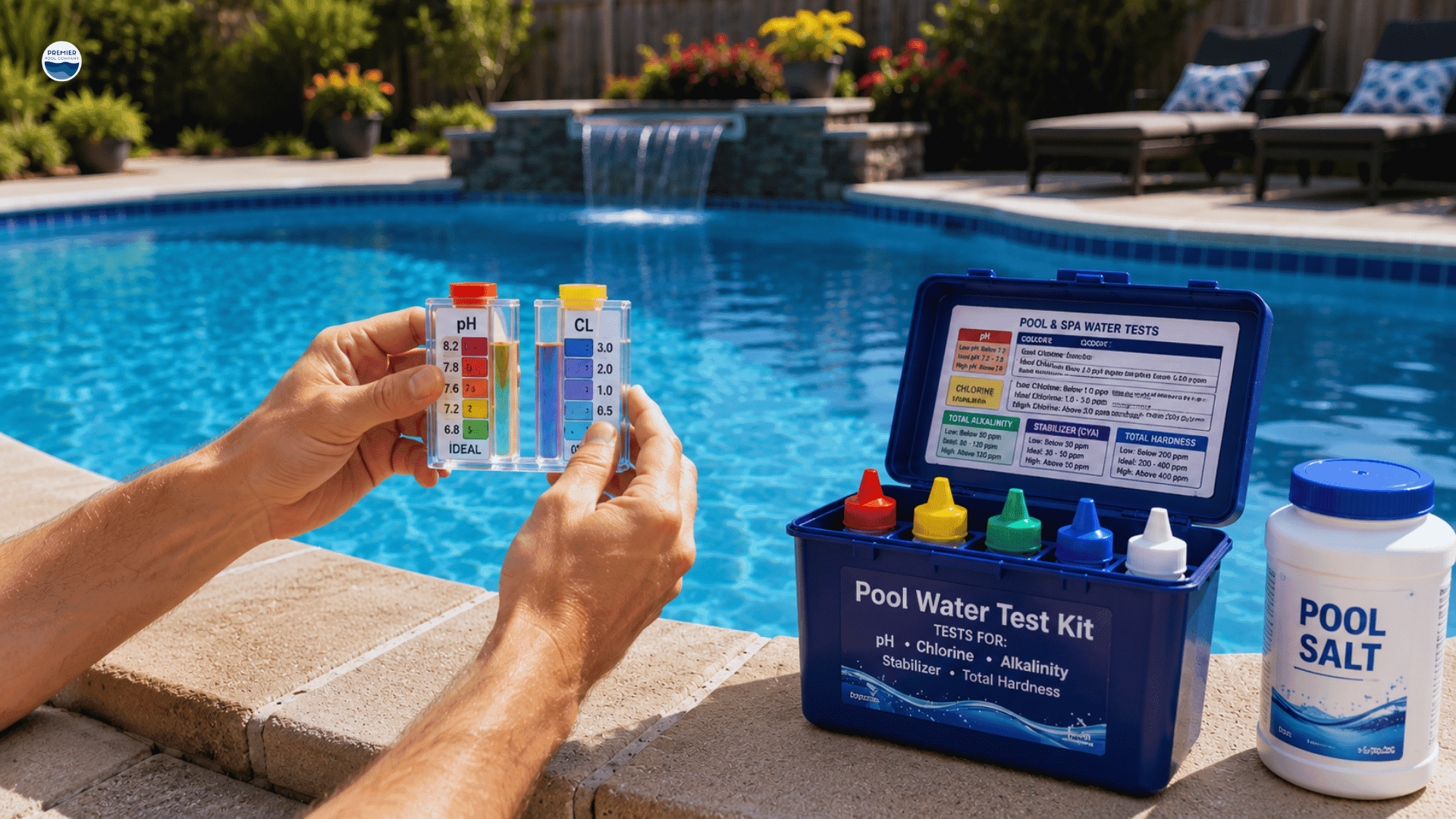
However, saltwater pools still require regular attention to pH, alkalinity, calcium hardness, and cyanuric acid (stabilizer) levels.
In fact, saltwater systems tend to push pH upward over time as a natural byproduct of the electrolysis process, meaning you'll often need to add more pH decreaser (muriatic acid or dry acid) than you would in a traditionally chlorinated pool. (So, no, you are not eliminating the use of chemicals here.)
The salt cell itself requires periodic cleaning and eventual replacement. Most cells have an effective lifespan of three to seven years depending on water hardness, run time, and maintenance.
A replacement cell typically costs between $200 and $900 depending on the generator brand and model. This recurring cost doesn't exist in a traditional chlorine system and should be factored into long-term ownership calculations.
Traditional Chlorine Maintenance: The Honest Case
Traditional chlorine pools have developed a reputation for high maintenance that isn't entirely fair.
Yes, they require more hands-on attention… You need to add chlorine regularly, and that means more frequent testing and product purchasing. But the trade-off is directness and control.
When something goes wrong in a chlorine pool, let’s say, algae begins forming, or the water turns hazy after a heavy rain, you have a clear and immediate toolkit for addressing it. You shock the pool, adjust the chemical balance, and the problem resolves predictably.
With a saltwater system, diagnosing problems involves an additional layer of troubleshooting: is it the salt cell running inefficiently? Is the salt level too low? Is the cell calcium-fouled and producing below its rated capacity? These are solvable questions, but they require more diagnostic knowledge.
For homeowners who are genuinely comfortable with pool chemistry, or who have a reliable pool service company, neither system presents unsolvable complexity.
For first-time pool owners or those who want the simplest possible troubleshooting process, the directness of a traditional chlorine system has real value that gets underappreciated in most comparisons.
Cost: The Honest Long-Term Picture
Upfront Costs
Installing a salt chlorine generator adds an initial cost to your pool build or conversion. A quality system from a reputable manufacturer such as Hayward, Pentair, Jandy, or Zodiac, runs roughly $500 to $1,500 for the generator unit, plus installation labor. This cost is absorbed into the overall pool price when you're building new, but for conversions it's an out-of-pocket line item.
Traditional chlorine pools have no specialized sanitization equipment cost beyond a standard pump, filter, and return system. This simplicity means a lower initial cost and fewer components that can fail.
Ongoing Costs
The ongoing cost comparison is where the calculation becomes genuinely complicated and heavily dependent on individual circumstances.
Saltwater pools eliminate or dramatically reduce spending on liquid chlorine, tabs, and shock; costs that, for an average residential pool, can total $300 to $600 per year or more in hot climates with heavy usage. Over five to ten years, that's a sizable figure.
However, offsetting this is the cost of salt (roughly $10 to $20 per 40 lb bag, with most pools requiring 6 to 10 bags annually at startup and less for top-offs thereafter), the replacement cost of the salt cell every three to seven years, and potentially higher acid consumption to counteract rising pH.
The below table provides a realistic side-by-side cost comparison for a mid-size residential fiberglass pool (approximately 15,000 gallons) over a five-year ownership period. These figures are estimates and will vary based on location, pool usage, and local product pricing:
Cost Category | Traditional Chlorine (5 Years) | Saltwater System (5 Years) |
Sanitization Equipment | $0 | $700–$1,200 |
Annual Chlorine/Chemical Cost | $1,500–$3,000 | $400–$900 |
Salt Cell Replacement | N/A | $300–$800 |
pH & Alkalinity Management | $400–$700 | $500–$900 |
Total Estimated Range | $1,900–$3,700 | $1,900–$3,800 |
Well, now that you see these side by side, it doesn’t look too different in terms of costs, does it?
So, saltwater systems cost more upfront and save only modestly on chemicals over time. You don’t really save that huge an amount as advertised most of the time.
Where they actually save the most money is on heavily used pools, like vacation rentals or large family pools, where manual chlorine costs add up quickly.
The Swimming Experience: The Differences Are Real
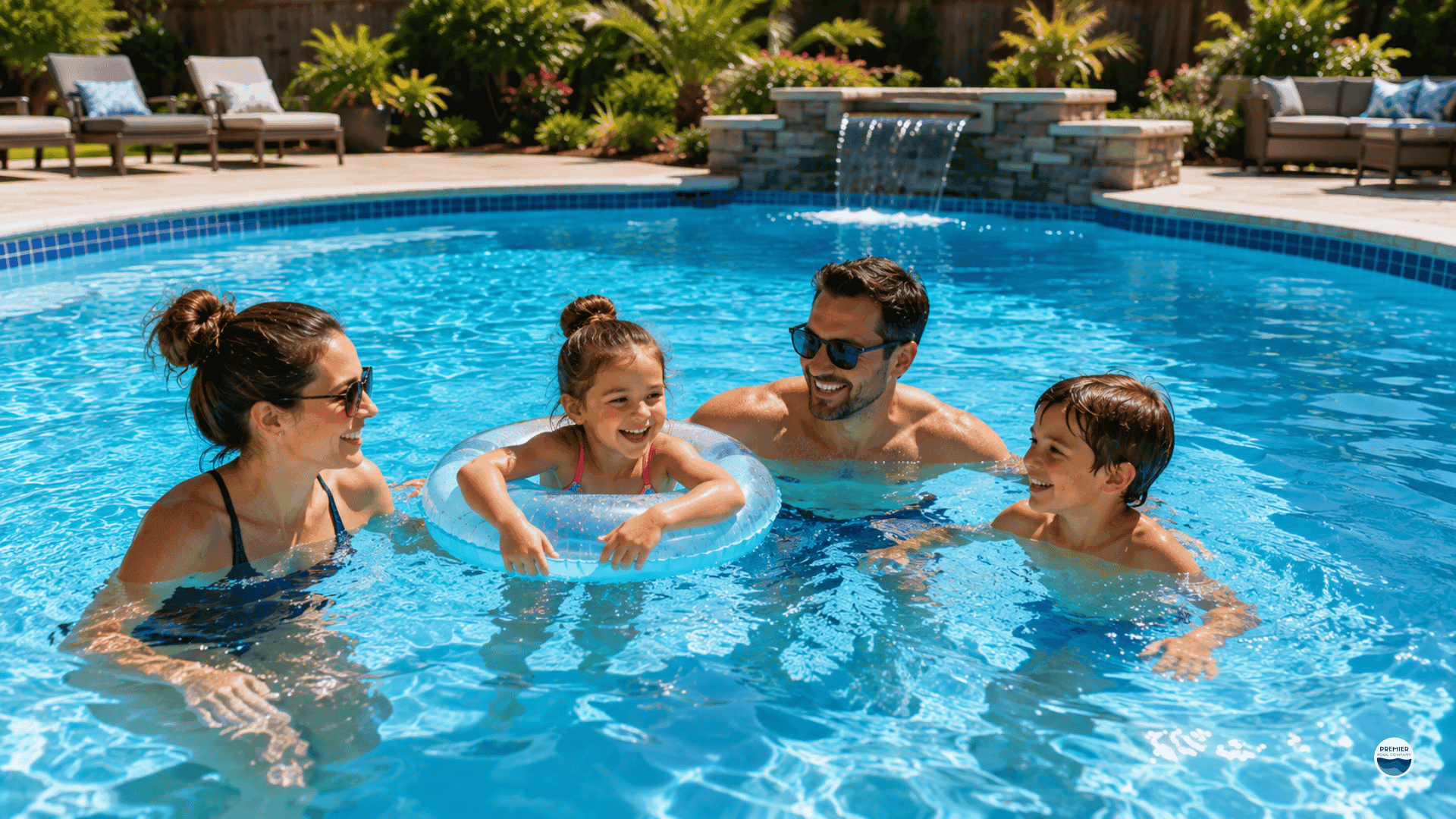
Why Saltwater Feels Different
The sensory experience of swimming in a well-maintained saltwater pool is genuinely different from that of a traditional chlorine pool. But let’s try to understand why.
The primary factor is chloramine reduction.
In a traditional chlorine pool where dosing is manual, it's common for chlorine levels to fluctuate. It rises after a fresh addition, then drops as the chlorine does its work and dissipates.
During periods of lower free chlorine and more people using the pool, combined chlorine compounds (chloramines) accumulate.
These are the compounds responsible for the sharp chemical smell, the reddened eyes after a long swim, and the skin irritation that many people associate with 'too much chlorine.' On the contrary, that smell actually indicates too little free chlorine, not too much.
A properly functioning salt chlorine generator maintains a more consistent free chlorine level, which means fewer opportunities for chloramine accumulation. The result is water that genuinely smells less strongly of chlorine and is gentler on eyes and skin.
The salt concentration itself (at 3,000 ppm, roughly one-tenth the salinity of seawater) contributes a mild softness to the water that many swimmers find pleasant.
For families with children who are particularly sensitive to chloramines, or for individuals with certain skin conditions like eczema, this difference in swimmer experience can be significant and is a legitimate reason to favor a saltwater system.
Skin, Hair, and the Body

The claim that saltwater pools are universally better for skin and hair requires some qualification.
At the concentrations used in pool water, the salt itself is unlikely to cause noticeable drying of the skin. However, chlorine, whether generated by a salt cell or added manually, is a potential irritant in both systems.
The key variable is free chlorine consistency and total chloramine load, which a well-tuned saltwater system handles better almost by default.
For swimmers with bleached or color-treated hair, neither system is without risk when chlorine is present. The idea that saltwater pools are categorically safer for dyed hair isn't a proven theory.
How to Choose: A Decision Framework for Fiberglass Pool Owners
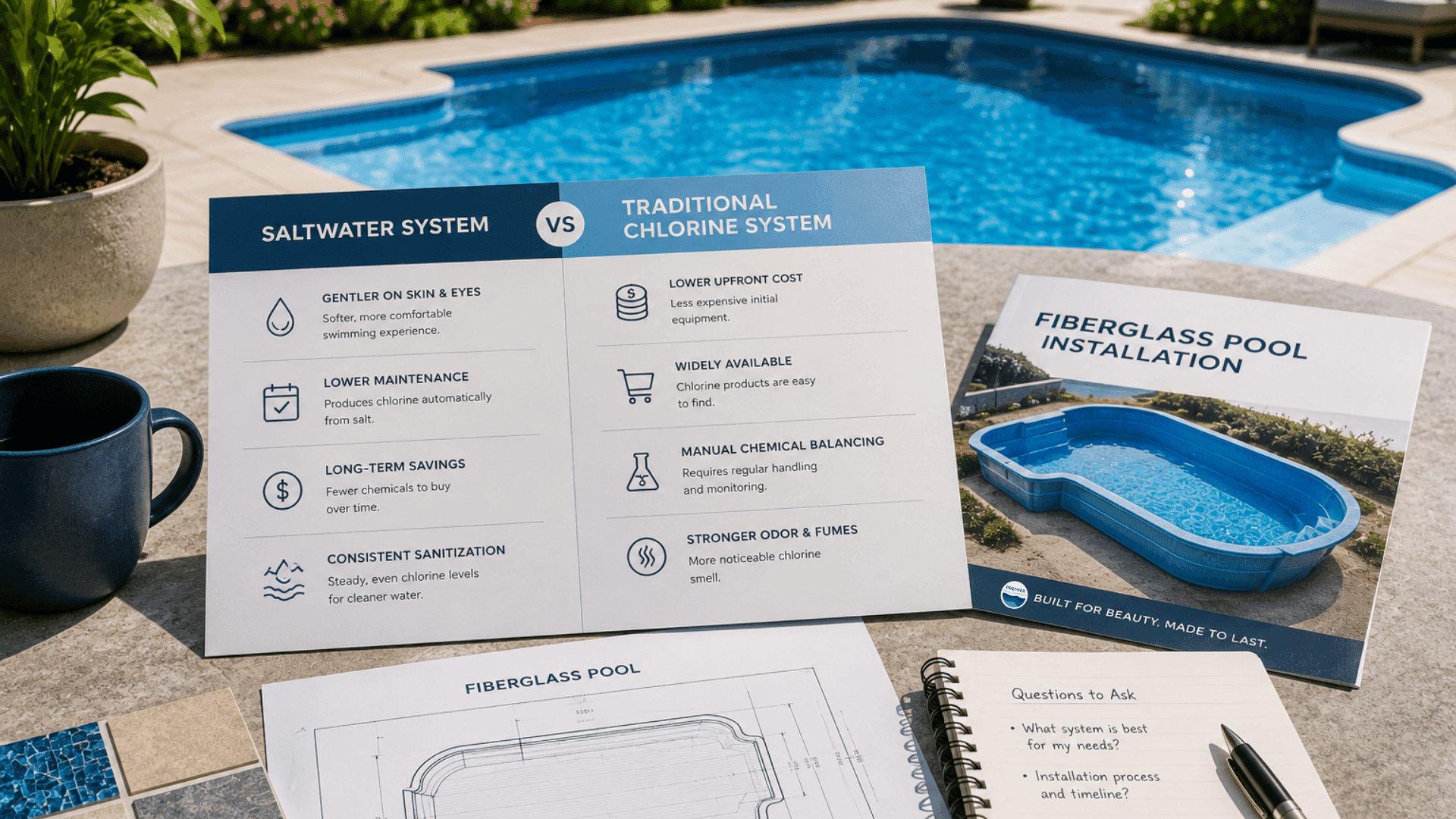
Rather than offering a generic recommendation, which would be dishonest given how much individual circumstances vary, I’ve decided to offer you a structured framework for thinking through the decision in the context of your specific situation.
Choose a Saltwater System If...
A saltwater fiberglass pool makes the most sense when several conditions align.
The strongest case is for households that want a consistently pleasant swimming experience without the daily hands-on management of chemical dosing.
If you're someone who tends to be intermittently attentive to pool care, i.e., active in the summer, less focused during busy stretches, the automated chlorine production by a salt system is more ideal.Saltwater is also a particularly good fit for pools that see heavy, regular use. High bather loads generate more chlorine demand and more chloramine production in traditionally dosed pools. A salt system handles this demand more smoothly, and the swimmer experience is noticeably better in heavily used pools.
If your fiberglass pool was built with quality 316-grade stainless fittings and your deck and landscaping are designed with salt tolerance in mind, the corrosion concerns are minimal and the system works harmoniously with the pool's construction. Confirming this with your pool builder before committing is worth the conversation.
Choose Traditional Chlorine If...
A traditional chlorine system makes more sense in several specific scenarios.
If budget is a genuine constraint, avoiding the upfront cost of a salt generator and installation makes sense, particularly if you're comfortable with pool chemistry and confident in regular maintenance.
It's also the right choice if you're installing a pool with older metal components, non-marine-grade fittings, or in a setting where salt spray on surrounding materials, such as a pool with ornate stone coping, a nearby herb garden, or metal-framed outdoor furniture nearby, is a real concern.
The lower dissolved salt content of a traditional chlorine pool reduces these peripheral risks.Finally, if you live in a region with hard water, you should know that saltwater systems can accelerate calcium scale buildup on the salt cell, requiring more frequent cleaning and potentially reducing cell lifespan.
In such climates, the ongoing maintenance advantage of a salt system narrows considerably.
The Question About Converting…
If you already own a chlorine fiberglass pool and are considering converting to saltwater, the process is straightforward:
inspect your current fittings for material quality,
purchase a salt generator system sized to your pool volume,
install it in line with your existing plumbing, add the initial salt charge, and dial in your generator's output level.
Most installations are completed in a day or less.
The one due diligence step you must do is having your pool's fittings, handrails, and anchor sockets inspected before converting. If these are lower-grade stainless, replace them with 316-grade hardware before adding salt to the water. This will save you from dealing with corroded components two years later.
Side-by-Side Comparison: Saltwater vs. Chlorine for Fiberglass Pools
Feature | Saltwater System | Traditional Chlorine |
Sanitization Method | Auto-generates chlorine via electrolysis | Manual chlorine dosing (liquid, tabs, or granular) |
Free Chlorine Level | 1–3 ppm (automated) | 1–3 ppm (manually managed) |
Swimming Feel | Softer, fewer chloramines, milder odor | Variable; sharper smell if imbalanced |
Upfront Equipment Cost | $500–$1,500+ | Minimal |
Annual Chemical Cost | Lower chlorine spend; higher acid use | Higher chlorine spend; moderate acid use |
pH Behavior | Tends to drift high | More stable |
Salt Cell Lifespan | 3–7 years (replacement cost: $200–$900) | N/A |
Fiberglass Compatibility | Excellent (shell); fittings require 316 SS | Excellent |
Maintenance Effort | Lower routine effort; more tech to manage | Higher routine effort; simpler to diagnose |
Best For | High-use pools, convenience-focused owners | Budget-conscious, DIY-oriented owners |
Frequently Asked Questions
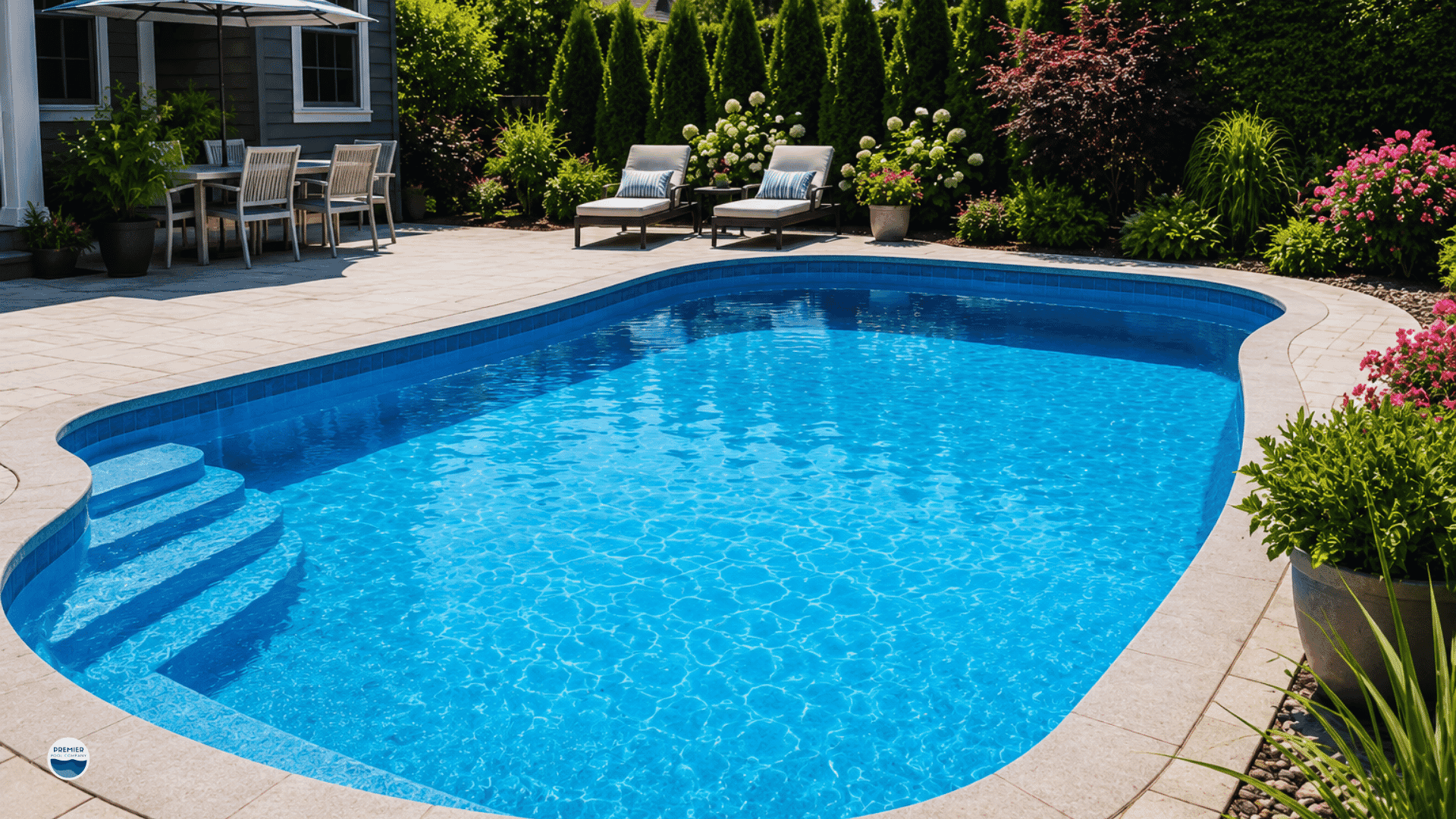
1. Can fiberglass pools be salt water type?
Yes and fiberglass is actually one of the best pool materials for a saltwater system. The gelcoat surface that gives fiberglass pools their smooth finish is a polyester resin, and it is chemically non-reactive to the salt concentrations used in pool water (typically 2,700–3,500 ppm, roughly one-tenth of ocean salinity). Unlike plaster, which can erode under aggressive water chemistry, or vinyl, which can become brittle over time, fiberglass gelcoat holds up exceptionally well in a saltwater environment.
The more important consideration isn't the shell, it's everything attached to it. Metal fittings, ladder anchor sockets, and handrail hardware vary significantly in quality between pool builds. Marine-grade 316 stainless steel handles saltwater without issue; the more common 304 stainless can develop pitting and corrosion over several years of sustained salt exposure. Before running a salt system in any fiberglass pool, it's worth confirming the grade of your existing hardware. If you're building new, specifying 316-grade fittings upfront is a small cost that prevents a larger headache later.
The short answer: fiberglass pools are fully compatible with saltwater systems, and many pool professionals recommend the pairing specifically because of how well the surface material holds up over time.
2. Can any fiberglass pool be converted to saltwater, or are there limitations?
Almost any fiberglass pool can be converted to a saltwater system, but the word 'any' deserves scrutiny. The fiberglass shell itself is not the limiting factor, it handles saltwater well. The real variables are your existing plumbing material (copper is vulnerable to salt corrosion and may need to be replaced), the grade of your stainless steel fittings and anchors, and whether your current filter and pump are rated for saltwater use. Before converting, have a qualified pool technician assess these components. In most cases, the conversion is straightforward; in some older builds or budget installations, some component upgrades are necessary to avoid problems.
3. How salty is a saltwater pool, really? Is it like swimming in the ocean?
Saltwater pools are dramatically less salty than the ocean. A typical saltwater pool runs at about 2,700 to 3,500 parts per million (ppm) of dissolved salt. The ocean averages around 35,000 ppm roughly ten times higher. The salt concentration in pool water is low enough that most people cannot clearly taste it, and it's not enough to cause significant skin drying or eye irritation in the way that sea swimming can. The sensation swimmers often describe a slight softness or silkiness to the water is real but subtle.
4. My saltwater pool keeps developing algae even though the generator is running. What's happening?
This is one of the most common problems I see with saltwater pools, and it's almost always caused by one of three things. First, the salt cell may be producing less chlorine than its rated output due to calcium fouling on the plates. Regular cleaning (typically every 90 days in hard water areas) is essential. Second, the stabilizer (cyanuric acid) level may be too high, a condition called chlorine lock, where free chlorine exists in the water but is rendered ineffective by excessive stabilizer. Third, the run time on the generator may be insufficient for the bather load and ambient temperature hot climates and heavily used pools require more daily run time. Check all three before assuming your equipment is failing.
5. Is it true that saltwater pools are easier on swimwear and pool equipment?
Partially true, with important qualifications. The lower and more consistent free chlorine levels in a well-maintained saltwater pool are somewhat gentler on textile fabrics than the chlorine spikes that can occur in manually dosed pools. However, chlorine in any form will degrade swimwear over time; the rate depends on chlorine concentration and total exposure. For pool equipment like pump seals, o-rings, and filter media, the salt itself is generally not a concern at pool concentrations, but the electrolytic activity of a salt system can accelerate corrosion in metal components that aren't designed for the environment.
6. Does the salt in the water damage the fiberglass gelcoat over time?
The honest answer is: not under normal circumstances. Fiberglass gelcoat is a polyester resin material, and it is fundamentally non-reactive to the salt concentrations used in pool water. Where gel coat degradation occurs osmotic blistering, surface oxidation, fading the causes are almost always water chemistry imbalances (particularly low calcium hardness or aggressive pH), UV exposure over time, or manufacturing defects, rather than salt content. A saltwater pool maintained with proper pH, calcium hardness (typically 200–400 ppm), and alkalinity should show no accelerated gelcoat wear compared to a traditionally chlorinated pool.
7. What happens to surrounding concrete and pavers with a saltwater pool?
This is an underappreciated concern that surfaces years into ownership for many saltwater pool owners. Salt-laden water that splashes onto concrete, natural stone, and certain pavers can cause efflorescence (white mineral deposits), surface spalling over time, and in porous stone, staining that is difficult to remove. The risk is proportional to splash frequency and drainage design. High-use pools with enthusiastic swimmers produce more splash. The mitigation is straightforward: use salt-resistant sealers on surrounding hardscape, ensure good drainage away from the pool, and rinse surrounding surfaces periodically. If your pool design incorporates salt-sensitive materials like certain limestone or travertine, discuss this explicitly with your builder before committing to a salt system.
Final Thoughts: What Decades of Watching Pools Teaches You
After observing hundreds of pool installations and conversions over many years, the pattern that stands out most clearly is this: pool owners who thrive are the ones who understand their system rather than simply having one installed.
Whether you choose a saltwater fiberglass pool or a traditional chlorine setup, the quality of your water, and the longevity of your pool, depends far more on consistent, informed maintenance than on which sanitization method you selected.
The difference between well-maintained salt and chlorine pools is small. Both are great; the real problem is neglect, poor chemistry, or hardware that isn't suited to the environment.
If I had to offer a single directional recommendation for most new fiberglass pool owners today, it would be this:
Saltwater systems are well-matched to fiberglass construction and deliver a genuinely better day-to-day experience for casual pool owners who want consistency without constant manual intervention.
But make sure to be prepared for what’s coming: budget for cell replacements, manage pH regularly, use salt-safe fittings, and don’t expect the system to run itself without periodic attention.
Whatever you decide, the investment in a fiberglass pool is substantial and worth protecting with the right information. The decision you make today will affect your family's enjoyment and your maintenance expenses for the next twenty to thirty years. So make it deliberately. If you need help our experts can guide you to choose the right one.
More Blogs

Aaron Lehner
Pool Water Testing in Ohio: A Beginner's Guide to Getting It Right
Pool water testing in Ohio was simple. Learn how to test chlorine, pH, alkalinity, and calcium hardness to keep your pool clear, balanced, and swim-ready.

Aaron Lehner
Paver Patio vs Concrete Pool Decks (Based on Ohio Climate)
Compare paver patio vs concrete pool decks in Ohio. Learn how pavers vs concrete patio options handle freeze-thaw cycles, drainage, heat, and maintenance.

Aaron Lehner
7 Best Pool Features To Add To Your Backyard In 2026
Discover the best pool features, custom pool features and swimming pool features for 2026, plus practical pool feature ideas that keep your Ohio backyard stunning and durable.