

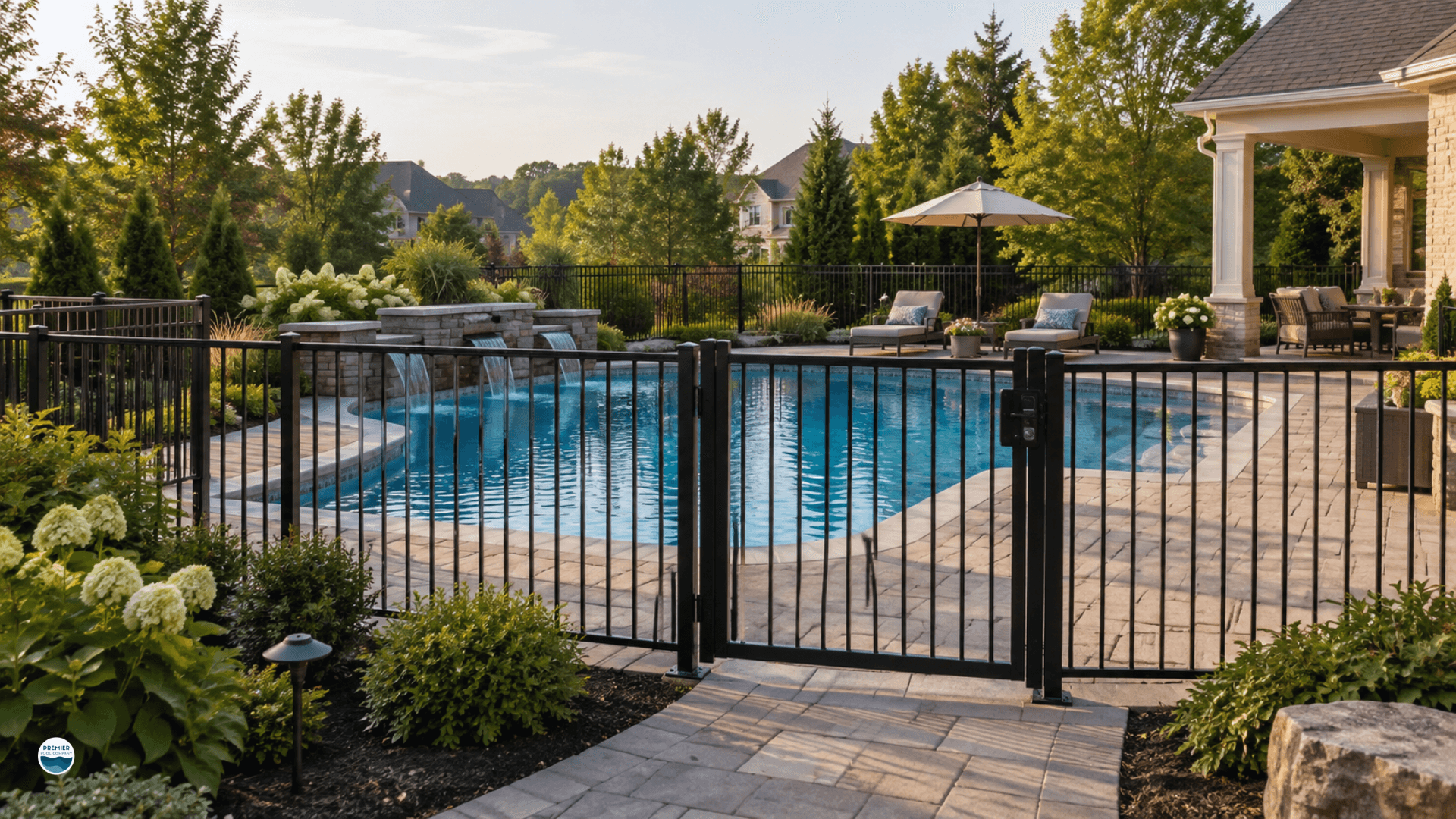
Pool Safety Regulations In Ohio - Everything You Need To Know
Owning a pool in Ohio comes with a few extra bits you need to learn. One of them is the pool safety regulations.
If you own a pool or are planning to have one built on your property, it’s best you gather some knowledge on the proper Ohio pool safety laws.
Although there isn’t a single list of rules. It has a split system: a detailed statewide code for public and semi-public pools, and a patchwork of hundreds of separate city, village, and township codes for the pool going into a private backyard.
Some people get confused about which way a gate should swing, while others may be worried about drowning-related liability files. The main issue here is that most homeowners get confused about which pool safety requirements to follow.
With this guide, we tried to sort that out. It covers what the State of Ohio actually controls, what gets decided city by city, where the two systems overlap, and where the real exposure sits once a pool is built. And these will help you understand that compliance with a building code and protection from a lawsuit are not always the same thing.
In fact, whether you are a homeowner planning a build, a property manager overseeing a rental with a pool, or a contractor trying to keep a client out of trouble, the goal here is to leave you knowing exactly which questions to ask your local building department before you dig.
TL;DR: All About Ohio Swimming Pool Laws At A Glance
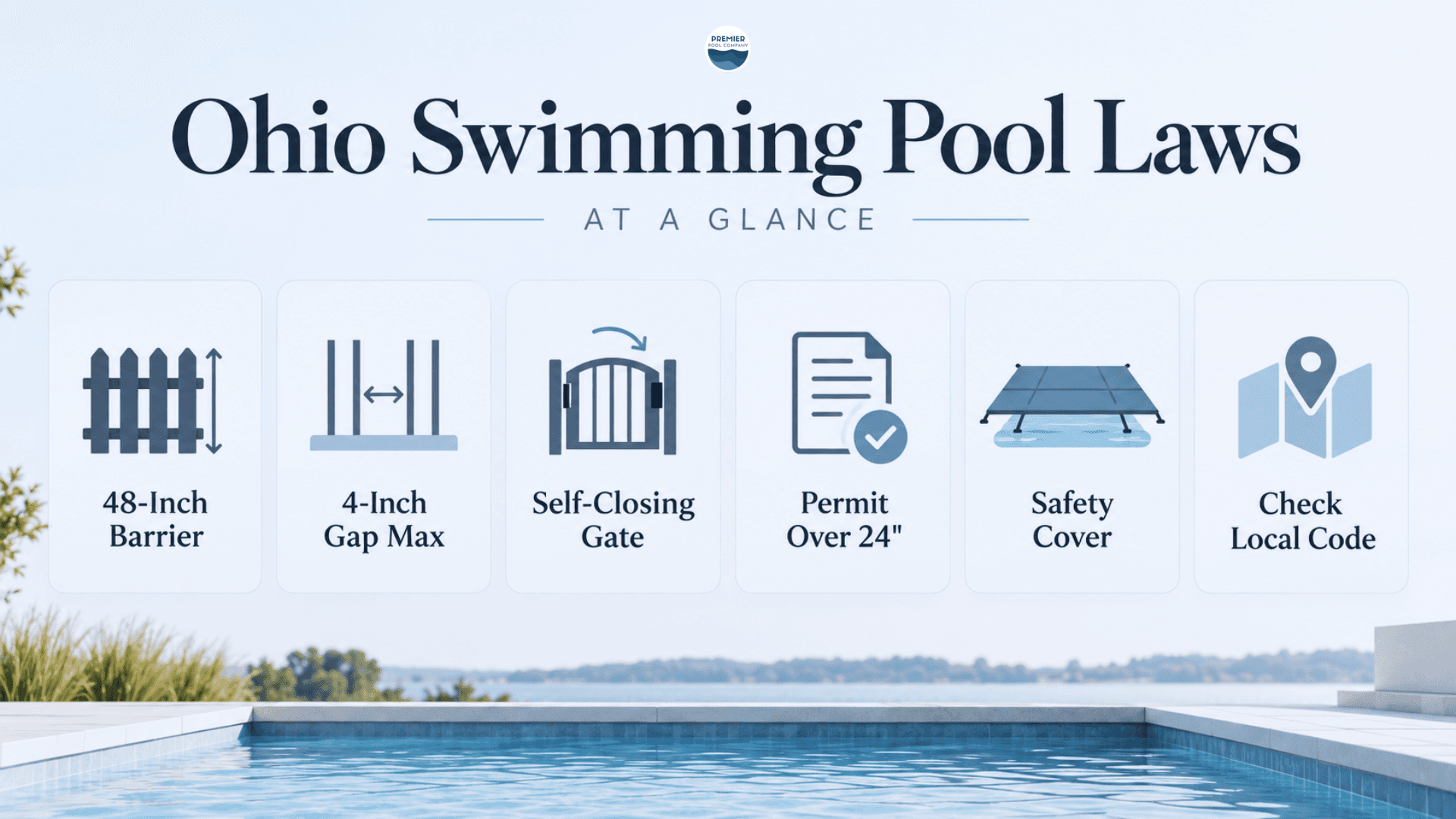
Ohio has no single statewide barrier law for private residential pools. That authority belongs to cities, villages, and townships, most of which have adopted some version of the Ohio Residential Code or the International Residential Code's pool provisions.
Public and semipublic pools in hotels, apartment complexes, clubs, or community pools are governed in detail, statewide, by the Ohio Department of Health under Ohio Administrative Code Chapter 3701-31, which sets a 48-inch minimum barrier and specific gate hardware rules.
Most Ohio municipalities require a 48-inch barrier, a 4-inch maximum gap (the “sphere test”), self-closing and self-latching gates that swing away from the pool, and fencing designed so it cannot be climbed.
A pool deeper than 24 inches, in-ground or above-ground, almost always triggers permitting and barrier requirements. Many homeowners with above-ground pools never realize that it applies to them as well.
Ohio recognizes the attractive nuisance doctrine for backyard pools, which means a swimming pool fence that satisfies your local code is not automatically enough to shield you from liability if a child is injured.
Power safety covers rated to ASTM F1346 and door alarms meeting UL 2017 can substitute for part of a barrier system, but only under narrow, specific conditions.
If you are confused about your situation or pool safety setup, then consider consulting pool experts (such as Premier Pools Co) to help you with it.
Why Ohio Splits Pool Law Between the State and Your City
You’d be wrong if you think Ohio regulates backyard pools the way it regulates, say, electrical wiring, i.e., through one statewide code that every jurisdiction enforces the same way. It doesn't work that way for residential pools.
Ohio is one of a number of states that never adopted a single statewide barrier statute for private pools, leaving that authority with local government.
What the state did do is take direct control of public and semi public pools, because those facilities serve strangers rather than one household, and the state has a public health interest in making sure a hotel pool in Toledo meets the same baseline as one in Cincinnati.
If you are building a backyard pool for your own family, your rule book is your city or township's zoning and building code, not a state health regulation.
If you operate a pool that the public or paying guests can access, such as in an apartment complex, a campground, or a swim club, you are dealing with the Ohio Department of Health, an annual license, and a much more detailed inspection regime.
If you mess this up, you may end up spending more for a setup you do not need, or not have the right regulations followed, leading to future legal issues.
What the State Actually Regulates: Public and Semi-public Pools
Ohio Administrative Code Chapter 3701-31 is the rulebook for public swimming pools, which is very prescriptive, unlike a private home swimming pool.
A licensed public pool must be enclosed by a perimeter fence or permanent structural barrier at least 48 inches tall, positioned so it actually prevents unauthorised access. Every gate or door in that barrier has to be lockable, and any gate used by patrons for regular entry and exit must be self-closing and self-latching.
Wading pools require a minimum 36-inch barrier separating them from the main pool, with gates that are self-closing and self-latching and a fence design on the inside that avoids horizontal rails a small child could use as a ladder.
Public facility operators also carry ongoing obligations around water depth signage, safety lines where the floor slope breaks between shallow and deep water, and licensing through the local or state health department, which means a public pool stays under periodic review for as long as it operates.
What Your City Actually Regulates: The Backyard Pool Barrier

The rule that governs Ohio pools was written by a city council or township trustee. Most of these local codes borrow heavily from the pool provisions in the Residential Code of Ohio and the International Residential Code, so the requirements tend to look similar from town to town even though the legal authority behind them is entirely local.
The common baseline runs like this:
a barrier at least 48 inches tall, measured from the outside grade;
no gap anywhere in the barrier large enough for a 4-inch sphere to pass through, which is the industry's way of testing whether a small child could squeeze through; and
If the fence uses horizontal and vertical members spaced 45 inches or more apart, the horizontal rails have to sit on the pool side of the fence so they can't be used as a foothold from outside. Gates carry their own specific requirements.
A code-compliant gate is self-closing, self-latching, and swings away from the pool, with the release mechanism positioned high enough that a small child standing at the gate can't reach it.
Homeowners frequently install an attractive gate that looks the part but latches on the wrong side, opens toward the water, or has a spring mechanism too weak to reliably close on its own. All of these may fail an inspection even though the fence itself meets height and spacing requirements.
The main difference you get with the city laws vs. the state laws is the details and the enforcement culture. Cincinnati's code, for example, calls for a minimum four-foot barrier with the gate latch also set at four feet. Akron has folded the statewide public-pool standard into its own residential requirements rather than writing something separate.
Columbus comes with its own zoning provisions, including setback distances and lighting rules for pool areas, on top of the general barrier requirement.
Above-Ground Pools, Safety Covers, and What Actually Counts as a Barrier
A surprising number of above-ground pool owners believe the pool wall itself is enough. In many jurisdictions, they're right, but only under specific conditions.
An above-ground pool must have a 48 inches thick wall as its barrier, provided the access ladder or steps are removable or lockable whenever the pool is not in use.
Ohio's local codes also recognise a couple of engineered alternatives to a swimming pool fence. A power safety cover that meets ASTM F1346 (an industry standard for covers strong enough to support an adult's weight and resist a child pushing against it) can satisfy the barrier requirement on its own in many
Separately, where a wall of the house itself forms part of the pool barrier and a door provides direct access, many codes allow a UL 2017-listed door alarm as a substitute for a fence gate at that specific opening, as long as it sounds immediately when the door opens and can't simply be switched off.
These alternatives are legitimate, but they come with narrower specifications.
The Permit You Didn't Know You Needed: Depth, Setbacks, and Timing
In most Ohio jurisdictions, any pool deeper than 24 inches, whether in-ground or above-ground, is treated as a regulated pool requiring a permit and a compliant barrier.
A soft-sided above-ground pool that fills to three feet of water meets that threshold in the same way as a gunite in-ground pool. Whichever you have, inspectors will check for the same regulations.
Setback distances are another concern. Requirements vary by municipality, but it's common to see pools required to sit somewhere between five and fifteen feet from rear and side property lines, with additional distance required from the house itself and from the street on corner lots.
Getting the setback wrong could lead to actions such as a zoning variance application or, worse, a pool that has to be relocated after it's already built.
The permit exists precisely to catch this before concrete gets poured, so it’s best to get this sorted out beforehand.
Attractive Nuisance: The Liability Layer Codes Don't Cover
Here is a distinction you have to understand: passing a building inspection and being protected from a lawsuit are two different things.
Drowning remains one of the leading causes of accidental death for young children in the United States, and Ohio courts, like courts in most states, apply what's known as the attractive nuisance doctrine to backyard pools.
Under that doctrine, a property owner can be held liable for injury to a child, even a trespassing child, if the property contains something inherently attractive and dangerous to young children and the owner failed to take reasonable steps to secure it.
A pool is the textbook example of an attractive nuisance, which means
a fence that technically satisfies your local barrier code could easily put you in trouble if it is left open,
a latch is broken and never repaired is a major issue, or
you know neighbourhood children regularly find their way onto your property, and you haven't done anything about it.
Courts generally look at whether a reasonable property owner would have recognized the pool as a hazard to children, whether children could realistically get onto the property, whether a child that age could be expected to understand the danger, and whether the owner acted to address the risk once it was known.
Meeting code is important. But you have to do everything you can to avoid trouble with the law. You have to ensure now children can get in harm's way due to your pool.
Pools at Daycares, Rentals, and Under HOA Rules

A few situations carry rules on top of the standard residential barrier code.
Family child care providers with a pool on the premises fall under a separate Ohio administrative rule that requires the pool to be made inaccessible to children in care through a fence or physical barrier.
Simply having a locked house door alone does not count. There are several other specific options, including a four-foot fence separating the pool from the play area or a secure cover meeting defined standards.
If you run in-home child care and have a pool, this rule applies regardless of what your city's general residential code says.
Rental property owners and landlords face a sharper version of the attractive nuisance exposure described above, simply because a rental brings in tenants, their children, and their children's friends, etc. As an owner, you can’t have full-time day-to-day visibility into this and can’t take action if anything happens when you aren’t present. Doing this automatically requires you to be extra careful.
If you own a rental with a pool, it is mandatory to treat the barrier and gate hardware as routine maintenance items, which need to be checked between tenancies; it's the baseline.
HOAs also come with this additional regulation:
A homeowners' association can impose barrier or fencing requirements stricter than what the city demands, and those private covenants are enforceable separately from, and in addition to, the municipal code.
Meeting your city's minimum doesn't mean you've met your HOA's rule, and the two should be checked independently.
How to Find Out Exactly What Applies to Your Pool
Given how much of this comes down to jurisdiction rather than universal rule, the most useful thing any Ohio pool owner can do is work through a short sequence before assuming anything.
Start by identifying whether the pool is private and residential or public and semi-public, since that single distinction determines whether you're dealing with your city's building department or the Ohio Department of Health.
From there, call your local building or zoning office directly and ask specifically about required barrier height, gate hardware and latch placement, minimum setback distances, and whether a permit is required before construction begins.
If you belong to an HOA, get its pool and fencing requirements in writing separately, since it won't necessarily match what the city requires.
The table below lays out how the two regulatory tracks compare at a glance.
Question | Public / Semipublic Pool | Private Residential Pool | Who Enforces It |
Governing rule | Ohio Admin. Code 3701-31 (statewide) | Local zoning/building code, usually Ohio Residential Code-based | Ohio Dept. of Health vs. local building department |
Minimum barrier height | 48 in. (36 in. for wading pools) | Typically 48 in.; some cities require more | Set by rule; verified at inspection |
Gate requirement | Self-latching, self-closing, lockable | Self-closing, self-latching, swings away from pool | Local building or health inspector |
Where the rule lives | One statewide administrative code | Hundreds of separate municipal and township codes | Varies; always confirm locally |
For anyone building new rather than retrofitting an existing pool, this is also the point where working with an established local builder is a wise decision. Full-service Ohio pool companies, such as Premier Pool Co, which works with Central Ohio homeowners on new construction and renovations, typically handle the permitting and code coordination with the local building department as part of the build itself, which removes a lot of the guesswork described above and catches setback or barrier issues on paper instead of after the concrete is poured.
FAQs
1. Does Ohio have one statewide law that tells me exactly how tall my pool fence needs to be?
No. That's the single most common misconception. Ohio regulates public and semipublic pools in detail through a statewide administrative code, but private residential pool barriers are set by your city, village, or township. Most local codes land on a 48-inch minimum, but you need to confirm the exact number with your local building department rather than assuming a statewide figure applies.
2. My above-ground pool is only three feet deep. Do I really need a permit and a fence?
In most Ohio jurisdictions, yes. The trigger most codes use is 24 inches of water depth, not pool type or size, and a three-foot above-ground pool clears that threshold just like an in-ground pool would. I've seen more than a few homeowners assume a seasonal above-ground pool falls outside the rules simply because it's not a permanent structure, and that assumption is usually wrong.
3. If my pool wall is already 48 inches tall, do I still need a separate fence?
Not necessarily. Many Ohio jurisdictions allow the pool wall itself to serve as the required barrier, provided the ladder or steps are removable or can be locked whenever the pool isn't in use. The condition that trips people up is leaving the ladder attached and accessible after swimming ends for the day, which effectively defeats the barrier even though the wall height is technically compliant.
4. Can a pool cover replace my fence entirely?
It can, under specific conditions. A power safety cover rated to the ASTM F1346 standard can satisfy the barrier requirement in many local codes without a surrounding fence. The key word is rated: a standard solar cover or a leaf net does not meet this standard, and inspectors will ask for documentation of the specific certification rather than take a homeowner's word for it.
5. If a neighbour’s child gets into my pool without permission and is injured, am I automatically liable?
Not automatically, but the risk is real, and it's a separate question from whether your fence meets code. Ohio recognizes the attractive nuisance doctrine, which can hold a property owner responsible for injuries to a child, even a trespassing one, if the property contains a foreseeable hazard like a pool and the owner didn't take reasonable steps to secure it. A code-compliant fence that's properly maintained is your strongest defence, but a broken latch you knew about and never fixed can undercut that defense even if the fence was compliant when it was built.
6. Does my HOA's pool rule matter if I already meet my city's building code?
Yes, and the two are enforced independently. An HOA can require a taller fence, specific materials, or additional restrictions beyond what your municipal code demands, and meeting the city's minimum does not satisfy a stricter HOA covenant. If you're in an HOA, get its pool and fencing rules in writing before you build, rather than assuming your building permit covers you on both fronts.
Final Thoughts

If there's one habit that could separate the Ohio pool owners who never have a problem from the ones who end up dealing with a citation, a failed inspection, or worse, it's this:
They stop treating the barrier as a one-time construction requirement and start treating it as a piece of ongoing safety equipment.
Gates get checked before pool season opens, not discovered broken mid-July.
Latches get replaced the moment they start sticking.
Covers get inspected for wear the way you'd inspect a smoke detector battery.
None of that is complicated, and none of it requires a lawyer or an engineer. You just need to know which rules actually apply to your specific pool, in your specific city, and treat compliance as a habit for the long-term.
Ohio's split system, state oversight for public pools and local control for private ones, isn't going away, and it isn't likely to get simpler. The homeowners and operators who do well under it are the ones who ask their local building department the direct questions early, verify their gate hardware against the actual code language rather than a general online summary, and understand that a permit sticker and a lawsuit are governed by two different, if overlapping, sets of standards.
If you need help with a new pool, or understanding how your current pool would need improvements to meet these standards, you may get in touch with our experts at Premier Pool Co. You may contact us here.
More Blogs
Aaron Lehner
Pool Safety Regulations In Ohio - Everything You Need To Know
Learn Ohio pool safety regulations, including pool safety requirements, swimming pool fence rules, permits, gates, barriers, and local laws.

Aaron Lehner
Do Pools Add Value To A House In Ohio?
Do pools add value to a house in Ohio? Learn how pools affect resale value, appraisal, costs, buyer demand, and when an inground pool makes sense.

Aaron Lehner
Pool Water Testing in Ohio: A Beginner's Guide to Getting It Right
Pool water testing in Ohio was simple. Learn how to test chlorine, pH, alkalinity, and calcium hardness to keep your pool clear, balanced, and swim-ready.