


Do Pools Add Value To A House In Ohio?
I've spent years around pool builds and personally dealt with several appraisals and the resale conversations that happen six months, six years, and sometimes sixteen years after a pool goes into the ground.
The question "Do pools add value to a house?" is actually quite common here in Ohio, and today, I’ve decided to share my knowledge on the matter with you.
Here's the short version, and then I'll walk you through why it's true.
A pool in Ohio can add real, appraisable value to a home, but it almost never returns what you spend to build it, and how much value it adds depends heavily on your neighborhood, your climate-driven swim season, and how the local market treats pools as a feature rather than a novelty.
This isn't a sales pitch, and it isn't a warning to scare you off. It's the version of this conversation I'd have with a neighbor over a fence, based on what actually happens when Ohio homes with pools go to market.
TL;DR - Key Takeaways

Nationally, in-ground pools tend to add somewhere between 5% and 8% to a home's value in a cold-weather state like Ohio.
As per current estimates, appraisers in Ohio typically credit an in-ground pool at $15,000 to a maximum of $40,000 above a comparable home without one, which is well under the cost of building and maintaining the pool (ranging between $50,000 and $91,000).
Ohio's swim season runs roughly May through September, which caps how much daily-use value buyers assign to a pool compared to Sun Belt states.
Neighborhood comps add significant value, a pool in a subdivision where pools are common performs very differently than a pool where yours is the only one on the street.
Above-ground pools add little to no appraised value in Ohio and can be a negotiating point against you.
The decision to build should be made primarily as a lifestyle purchase, with resale value treated as a partial offset, not the reason to build.
Thinking about a pool for your Ohio home? Contact Premier Pool Co. for a free consultation and a project estimate tailored to your backyard, budget, and goals.
The Honest Answer: It Depends on Ohio's Specific Math
To be plain and straightforward with you, the appraised value a pool may add to the real estate usually has far less value than the emotional value it holds for the homeowner.
A kitchen remodel or a finished basement tends to track fairly closely to what you spent. A pool almost never does, and Ohio's climate is a big part of why.
Swimming pools are valued by comparison, not by replacement cost. An appraiser doesn't look at your $75,000 pool and add $75,000 to your home's value. Instead, they look at recent sales of comparable homes in your area, some with pools, some without, and measure the actual price difference buyers paid. That method is called paired sales comparison and is commonly used for valuation.
In a warm-weather market where pools are used nine or ten months a year and nearly every comparable home has one, pools are considered to be of more value.
In Ohio, where the swim season realistically runs from mid-May through early September and plenty of comparable homes don't have pools at all, the gap tends to be smaller. That doesn't mean nonexistent; it just means proportionate to how much actual daily-use value the pool delivers in your climate and your specific market.
What Ohio Appraisers Actually Do With a Pool
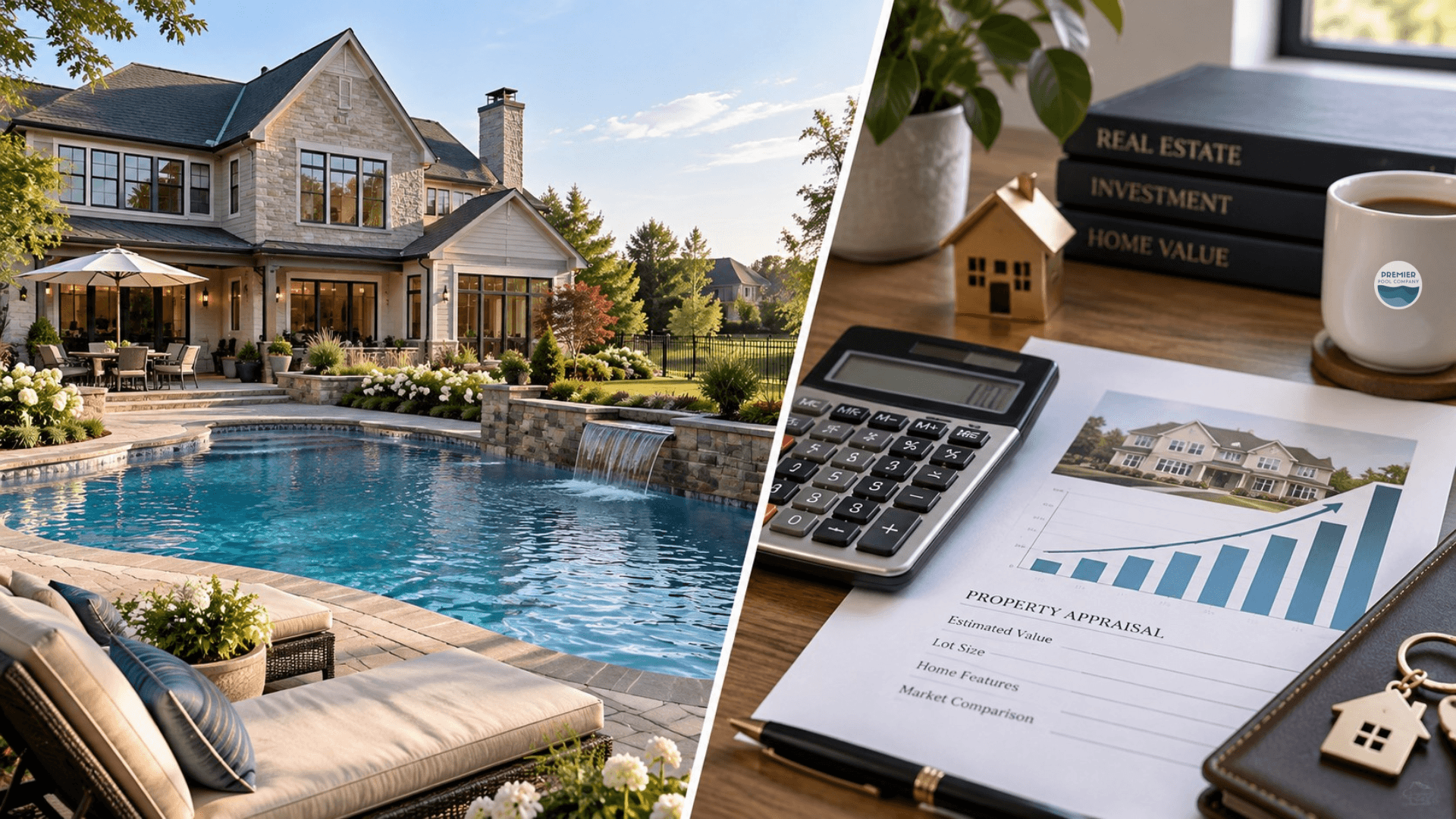
When there are enough recent nearby sales of pool and non-pool homes to compare, an appraiser will typically credit somewhere between $15,000 and $40,000 for a well-built, well-maintained in-ground pool.
The amount you get in that range depends on the pool's condition, its age, and the quality of decking &fencing around it. Plus, as I mentioned earlier, how many other comparable sales in the area actually included a pool will weigh in on the estimate.
If pools are rare in your neighborhood, the appraiser has thin data to work with and may apply a smaller adjustment, or none at all, simply because there isn't enough evidence to support a larger number.
If you're in a subdivision where a third of the homes have pools, and they consistently sell for more, then you can get a generous adjustment because the market suggests pools are in demand. This is also where above-ground pools fall out of favour.
Most Ohio appraisers won't credit an above-ground pool on the appraisal at all unless it's a permanent, semi-inground structure integrated into the landscaping.
If you're building specifically with resale in mind, do understand that an above-ground pool is a lifestyle purchase, full stop. It doesn’t add value to the property itself.
The Real Ohio Numbers: Cost vs. Value
The following are certain numbers I will present to you based on estimated values in the area. But do note, these may vary depending on the quality, location, and the pool builders you work with after consultation and negotiations.
I always suggest it’s best to pay more for quality than to risk pain later. So it shouldn’t discourage you from working with expert pool builders.Before deciding on a pool type, compare the fiberglass inground pool pros and cons and the long-term benefits of fiberglass pools for Ohio homes.
I'll put the numbers in front of you plainly, because vague ranges don't help anyone budget.
As of 2026, a complete in-ground pool installation in a Columbus-area market runs somewhere between $50,000 and $91,000 for a standard project.
Fiberglass builds in Central and Southwest Ohio commonly land between $75,000 and $110,000, depending on size.
Statewide averages pull lower once you include smaller cities and vinyl-liner builds, with some regions seeing complete installs in the mid-$30,000s to low-$60,000s range. And these figures don’t include any extra modifications or maintenance costs you may have incurred.
Ohio law requires a barrier at least 48 inches tall around residential pools, with self-closing, self-latching gates, and a standard 300 linear feet of fencing typically runs around $6,500.
Concrete decking for a modest pool area adds roughly $12,000.
A heater to stretch the short Ohio swim season into the shoulder months runs close to $4,300, and pool automation systems that most buyers now expect as a baseline convenience add another $4,800 or so.
By the time decking, fencing, permits, and equipment are factored in, a homeowner who budgeted $60,000 for "a pool" can easily find themselves at $85,000 to $100,000 for the finished backyard.
Set that total cost against an appraised bump of $15,000 to $40,000.
A well-built pool in Ohio typically recoups somewhere in the range of 30% to 50% of its construction cost at resale, occasionally more in the right neighborhood, occasionally less in the wrong one. That's simply how it works in cold-weather markets, and it's consistent with what national resale studies report for regions outside the Sun Belt.
Cost Component | Typical Ohio Range (2026) |
|---|---|
Inground pool shell + installation | $35,900 – $110,000 |
Fencing (48" code-compliant) | ~$6,500 |
Concrete decking (standard area) | ~$12,000 |
Pool heater | ~$4,300 |
Automation system | ~$4,800 |
Typical appraised value added | $15,000 – $40,000 |
**Note: These are estimated values. It will vary depending on brand, contractor, and quality.
Neighborhood Comps Matter More Than the Pool Itself
If there's one thing I wish every Ohio homeowner understood before signing a contract, it's this: the pool doesn't determine its own value; the neighborhood does. I've seen identical pools, built by the same contractor in the same summer, perform completely differently depending on which zip code they landed in.
In established, higher-end suburbs around Columbus (such as communities like Dublin, New Albany, and Powell, where larger lots and higher price points are the norm), a well-designed pool tends to be viewed by buyers as an expected amenity rather than a luxury. Comparable sales support a stronger adjustment because enough pool homes have transacted nearby for the appraiser to point to.
In older, tighter-lot neighbourhoods inside the urban core, or in starter-home subdivisions where the typical buyer is a young family stretching their budget, a pool does add value to the property. It takes away usable yard space, adds a line item buyers have to budget for in insurance and maintenance, and narrows your buyer pool to people specifically looking for one. Now, if you expect to move in a year or two, then it’s best to first analyse if a pool is worth it at this point. Before you build, look at what's actually selling on your street and in your immediate subdivision.
If pools are common and comps show a price premium, you're building into a market that already values the feature.
If you'd be the only pool on the block, you're building for yourself, which is a perfectly good reason, just not a resale-driven one.
Regardless, if you are okay with having a pool for your own satisfaction and luxury, and do not care about the resale value, then you really don’t need to do all this research. You can think about it when you are ready to move and sell the house.
Where In Ohio Do Pools Perform Best And Worst In Terms Of Property Value

Regional differences inside Ohio are quite pronounced.
Central Ohio's clay-heavy soil around Columbus and Central Ohio's flatter terrain generally keep excavation costs more predictable.
The rocky ground you'll run into in Eastern and Southeastern Ohio are less predictable, as site prep can add thousands to a project before the pool itself is even poured.
Western Ohio and the Dayton area tend to see more accessible sites and correspondingly lower installation costs, which gives a better cost-to-value difference.
On the value side, higher-priced metro suburbs with larger average lot sizes consistently show stronger paired-sales support for pools than smaller cities and rural markets. That’s because a pool takes up a bigger percentage of the home's overall space, and a smaller percentage of buyers are shopping specifically for a property with a pool included.
This is a big part of why working with an experienced, locally established builder matters as much as the pool itself. A company like The Premier Pool Co, which has built extensively across Ohio's varied soil and permitting environments, understands how to build a structurally sound pool and how to design and site it in a way that fits what buyers in that specific market actually expect.
So if you are planning to move and still want to get a pool now, it’s best you get an expert to work on it so that you get maximum value both now and during re-sale.
You may contact Premier Pool here.
The Nine-Month Problem: Why Cold Climates Cap Pool ROI
I call this the nine-month problem because that's roughly how much of the year an Ohio pool sits unused, covered, or winterized.
A realistic swim season here runs from mid-May through early September, with shoulder-season use possible if you've invested in a heater.
Compare that to Florida, Texas, or Arizona, where a pool might see meaningful use nine or ten months a year, and you can see immediately why the same pool draws a bigger price premium in those markets.
Buyers intuitively price this in, even if they've never seen an appraisal report. A pool that's usable for four to five months a year delivers less annual value than one usable most of the year, and that has a high impact on what people are willing to pay for it at resale.
It also means the winterizing, opening, and off-season maintenance costs Ohio pool owners carry every year (pool cover systems, chemical balancing before and after closure, equipment checks) are costs that a Sun Belt pool owner largely avoids. None of this means a pool isn't worth building in Ohio. It means the ROI ceiling here is structurally lower than in warmer states, and no amount of upgraded finishes changes that.
Proper off-season care protects your investment, so review our guide on how to winterize a pool in Ohio before your first winter as a pool owner.
Decision Framework: Should You Build a Pool for Value or for Life?
The homeowners I've seen end up happiest with their decision are the ones who separate two different questions early:
"Will this pool make my life better for the years I'll actually live here?"
"Will this pool help or hurt me at resale?"
The two questions hold completely different emotional values.
If you're planning to stay in the home for eight, ten, or more years, and you have children or grandchildren who'll use the pool regularly, the lifestyle value alone often justifies the cost, and the resale recovery becomes a nice bonus rather than the point.
But if you're planning to sell within two or three years, or if you're in a starter-home price bracket where the pool would represent a large percentage of the home's total value, the math gets harder to justify on financial grounds alone, and you should weigh it accordingly.
A few questions worth working through before you commit, in case you are more concerned about the resale value:
What does your home's price point suggest about your likely buyer: a family looking for a backyard amenity, or a first-time buyer stretching to afford the mortgage?
How many comparable homes within a half-mile already have pools, and what have they sold for relative to non-pool homes?
How many years do you realistically expect to stay in the home before the resale question even becomes relevant?
Can your budget absorb the full picture, fencing, decking, heating, insurance increases, and annual maintenance, not just the pool shell itself?
Would a heater or automation upgrade meaningfully extend your actual usable season, and is that worth the added cost to you personally?
There's no universally correct answer here. There's only the answer that fits your specific timeline, your specific neighborhood, and your specific reasons for wanting a pool in the first place.
FAQs
1. Does a pool increase property taxes in Ohio?
Yes. Ohio county auditors reassess property improvements, and a permanent in-ground pool is typically classified as a taxable structure. Homeowners should expect their assessed value and their annual property tax bill to rise after installation, which is a cost that's easy to forget when budgeting for the build itself.
2. Is a fiberglass or concrete pool better for Ohio's climate?
Fiberglass pools have become the more popular choice across Ohio in recent years, largely because of their freeze-thaw resistance. Ohio's winters put real stress on pool surfaces, and fiberglass shells tend to hold up better against that cycle than gunite or concrete over a long ownership period, though concrete still offers more design flexibility for custom shapes.
You can also compare the best pool materials for an Ohio backyard before choosing the right fit for your design, maintenance goals, and budget.
3. Will a pool make my Ohio home harder to sell?
It can, depending on your buyer pool. In neighborhoods where pools are common and expected, a pool is rarely a deterrent. In starter-home markets or areas with a large share of young families prioritizing yard space for kids or pets, a pool can narrow your buyer pool and occasionally become a negotiating point rather than a selling point.
4. How much does it cost to maintain a pool in Ohio each year?
Beyond the initial build, Ohio pool owners typically budget for seasonal opening and closing, chemical balancing, and equipment upkeep, which commonly runs into the low thousands annually depending on pool size and whether you hire a service company. Owners who document this maintenance consistently tend to have an easier time reassuring buyers about the pool's condition at resale.
5. Should I finance a pool if I'm building mainly for resale value?
I'd caution against it. Financing a pool adds interest costs on top of an investment that's already unlikely to return 100% of its construction cost. If resale value is your primary motivation, a pool is rarely the strongest dollar-for-dollar option compared to other home improvements, it makes far more sense as a financed purchase when it's driven by how much you and your family will actually use it.
6. Does the type of pool builder actually affect resale value?
It affects it more than most homeowners expect. A pool built by an experienced, established local company, one familiar with Ohio's soil conditions, permitting requirements, and code-compliant fencing tends to hold its structural integrity and appearance longer, which directly supports a stronger appraisal years down the line. A poorly sited or poorly built pool becomes a maintenance liability that erodes value instead of adding it.
Final Thoughts

My honest opinion regarding this matter is this: build a pool because you and your family will use it and enjoy it, not because you expect it to pay for itself at closing.
The data is consistent enough that I'd call it a rule rather than a guideline: Ohio pools typically recoup 30% to 50% of their construction cost through appraised value, occasionally more in pool-friendly, higher-end neighborhoods, occasionally less where pools remain uncommon.
So, it's not the kind of return that makes a pool a financial investment in the way a kitchen remodel or an added bathroom can be. But it will add value to your livelihood.
If you go into the project with clear eyes about that trade-off, budget for the full cost, not just the shell, and choose a builder who understands how to site and construct a pool that fits your specific neighborhood's expectations, you'll end up with a backyard that adds genuine value to your daily life and a reasonable, honest bump to your home's worth when the time comes to sell.
You can contact Premier Pool Co anytime to discuss further on the matter. Contact us here.
More Blogs
Aaron Lehner
Do Pools Add Value To A House In Ohio?
Do pools add value to a house in Ohio? Learn how pools affect resale value, appraisal, costs, buyer demand, and when an inground pool makes sense.

Aaron Lehner
Pool Water Testing in Ohio: A Beginner's Guide to Getting It Right
Pool water testing in Ohio was simple. Learn how to test chlorine, pH, alkalinity, and calcium hardness to keep your pool clear, balanced, and swim-ready.

Aaron Lehner
Paver Patio vs Concrete Pool Decks (Based on Ohio Climate)
Compare paver patio vs concrete pool decks in Ohio. Learn how pavers vs concrete patio options handle freeze-thaw cycles, drainage, heat, and maintenance.