


Do Fiberglass Pools Crack In Cold Weather As Per Ohio's Climate Changes?
Building a swimming pool in Ohio comes with several concerns for homeowners. And it's understandable. The climate here is tricky, especially during those momentary freeze-thaws.
And when suggesting fiberglass, we did get the question, "Do fiberglass pools crack in cold weather?" quite a few times, especially from owners getting a new swimming pool or people preparing for those first winter freeze-thaws.
Why not? Fiberglass is expensive, and the thought of needing to repair it is sometimes overwhelming
And we all know, Ohio's climate isn't gentle on anything buried in the ground. Frost heave is a real, documented issue here, and it's completely natural to wonder whether a pool shell will be able to withstand the sudden short-term hard freezing.
If you ask us, do fiberglass pools crack? The material is very strong and hard to crack. But it's not completely resistant. It depends on a lot of factors, including the way fiberglass is used during pool construction, how it's maintained, and how you prepare the pool for Ohio winter.
We'll discuss all of that in this article.
TL;DR - Quick Glance At What You Will Learn

Fiberglass itself is flexible enough to handle Ohio's freeze-thaw cycles without cracking from cold alone; the shell is not outright rigid and moves with ground pressure.
Most "cracks" homeowners see are cosmetic gelcoat crazing or spider cracks, not structural failures reaching into the laminate.
Real structural cracking traces back to installation shortcuts like poor base prep, loose backfill, skipped engineering for Ohio's clay-heavy soil, etc., and not the thermometer.
Winter water-level mistakes, especially draining or lowering below the skimmer, create more fiberglass pool damage in Ohio than the actual ice.
Ohio's frost line runs anywhere from roughly 24 inches in the southwest to over 40 inches near Lake Erie; this should shape how your pool and its plumbing get installed and winterized.
A pool built and closed correctly can go through decades of Ohio winters and never develop a structural crack.
It’s best to handle your pool’s construction with experts (such as Premier Pool Co), or if you see cracks and need repairs.
Fiberglass Handles Cold Better Than People Assume
The pool industry spent decades selling concrete and gunite as the "serious" option and fiberglass as something closer to a novelty. However, we’d like to think fiberglass is actually the best option in Ohio.
A fiberglass pool shell is a single molded piece: chopped strand fiberglass and woven roving saturated in polyester or vinyl ester resin, with a gelcoat surface layer on top.
This combination behaves like a composite spring, unlike a concrete or gunite setup, which acts like a rigid slab.
When frozen ground swells against the outside of the shell, or when the water inside contracts slightly as it cools, the laminate is able to absorb that movement without fracturing.
Concrete doesn't have that property. It's rigid and porous. When water gets into hairline surface cracks and freezes, the expansion forces new cracks to open in the material. Cold weather is genuinely harder on gunite and shotcrete pools than on fiberglass ones.
So, it’s safe to say fiberglass is more of an advantage over other options.
But it is not 100% immune to problems. A shell doesn't need Ohio winters to develop a hairline in the gelcoat. A poorly cured resin batch, a bump during transport from the manufacturer, or UV degradation over fifteen summers can all damage the gelcoat.
What Ohio's climate adds is one extra concern: ground movement. And ground movement only becomes a cracking problem when the soil underneath the pool wasn't prepared to handle it in the first place.
Understanding Gelcoat Crazing, Spider Cracks, and Structural Cracks - They Are Not The Same
For most of us, any thin line crack to large visible cracks mean the same; We’d think maybe the shell has cracked.
But in reality, there are different types of cracks that may happen for different reasons, and the repair costs vary accordingly.
Gelcoat Crazing
Gelcoat crazing is a fine spiderweb of surface lines in the colored top coat. And it doesn't go anywhere near the structural laminate underneath.
How bad this goes really depends on how thick or thin the gelcoat was applied at the factory, plus long-term UV and chemical exposure.
Spider Crack
This is similar to gelcoat crazing, but radiates outward from a single point. For example, it can originate from somewhere the shell took an impact, like a dropped tool during construction or a heavy ladder set down in the same spot for years.
Both gelcoat crazing and spider cracks are quite harmless, and both can be repaired with a gelcoat patch.
However, a structural crack can be a menace.
Structural Crack
It passes through the gelcoat into the actual fiberglass-and-resin laminate. Meaning, it’s not a surface-level damage; the main material that holds the pool shell is cracked.
While it may appear as ordinary cracks from the surface, you will know it’s a structural crack when you notice water loss from time to time.
Structural cracks in a fiberglass shell are genuinely rare in the industry. But the good news is, it never happens due to the cold weather or the freeze-thaws in Ohio.
The most likely reasons it can happen on rare occasions are due to soil movement under an unevenly supported shell, a manufacturing defect that went unnoticed, or damage from an improper full drain-down.
What Actually Causes Fiberglass Pools to Crack - Ohio's Ground Movements In Question
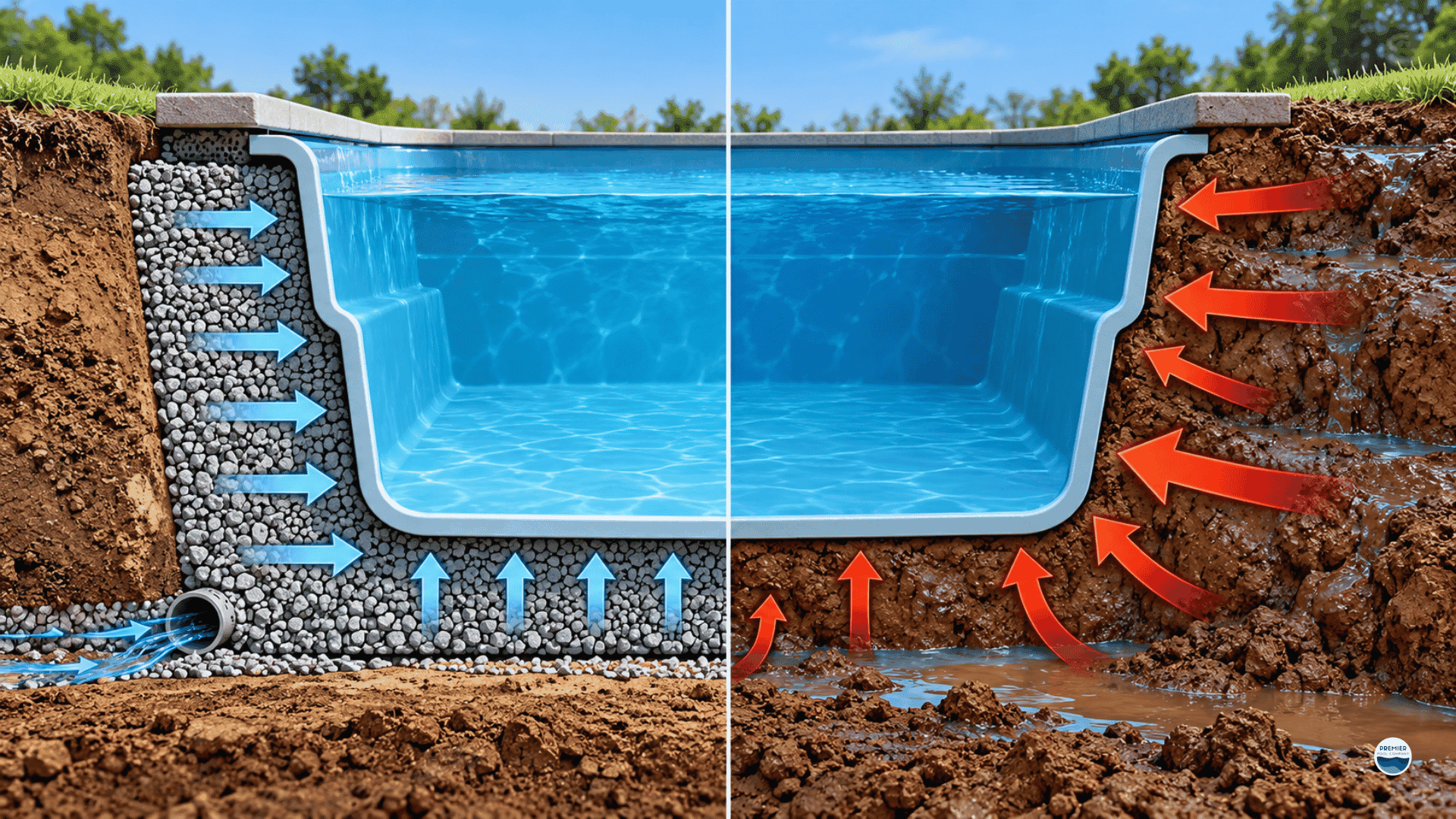
We know you asked if fiberglass is vulnerable to the cold climate changes in Ohio. But by now we believe you know it’s not.
In most cases related to a fiberglass pool crack in Ohio, the culprit is usually the soil underneath the shell.
Much of central and southwest Ohio sits on glacial till, i.e., clay-heavy soil that holds water and swells noticeably when it freezes.
This is particularly why residential foundation contractors in Ohio size footings so conservatively: the frost line runs roughly 24 to 30 inches deep around Cincinnati and Dayton, closer to 30 to 36 inches around Columbus, and can reach 40 inches or more up near Cleveland and the Lake Erie counties.
It’s important to engineer a pool base with that range in mind, or there’s guaranteed exposure to uneven frost heave. And this uneven support is the single biggest reason behind fiberglass pools cracking structurally.
Backfill choice is also an important factor.
A shell backfilled with clean, well-compacted crushed stone drains water away from the pool wall and resists the freeze-thaw swelling that clay does.
A shell backfilled with the same clay dug out of the hole (a shortcut some crews still take to save a truckload of stone) will hold moisture against the pool wall all winter. This will expand and push unevenly when it freezes.
In short, two of the most common reasons for cracks in fiberglass pool structures in Ohio are backfill that was never upgraded from native clay or a base that wasn't compacted evenly before the shell went in.
And as you can tell, the issues here are not due to the cold weather. It’s mostly due to improper installation.
However, there is one more reason you may want to learn about.
Hydrostatic pressure
Groundwater sitting outside the shell pushes inward; the water sitting inside the pool pushes outward and balances it.
To maintain this balance, you should never fully drain a fiberglass swimming pool without a professional managing groundwater conditions first.
If you pull the counterweight of water out, the empty shell in saturated Ohio clay can shift, bulge, or in rare cases, float right out of the ground.
Winter makes this worse in one specific way: frozen groundwater around the shell expands the same way frozen soil does, and if a pool was drained too low or fully emptied going into winter, that pressure has nothing pushing back against it from the inside, leading to structural cracks.
In this case, the winter does play a part, but only because the water draining is not properly maintained.
Winterizing Mistakes Do More Damage Than Ohio Winters Do

Winterizing pools is important in Ohio and is always a routine every year. However, due to certain negligence, you could damage the pool.
You see, fiberglass doesn't winterize the same way concrete does.
Concrete pools often get shocked hard and have calcium hardness pushed up before closing, because concrete surfaces can tolerate it.
The same doesn’t work with fiberglass pools. It will cause scale to bond directly onto the gelcoat, which shows up as a stubborn gray or white haze the following spring.
Fiberglass needs balanced chemistry going into winter, not aggressive chemistry.
And as mentioned earlier, water level is a major issue.
Lowering the water below the skimmer (which is a standard practice on plenty of concrete and vinyl pools) reduces the internal pressure holding a fiberglass wall in its proper shape. If you do it for four or five months across an Ohio winter, you may end up with wall bulging, plumbing shifted out of alignment, and cracks around stress points.
The equipment side matters too.
Anything left above the local frost line, such as exposed plumbing runs, an unprotected pump housing, etc., will face the same freeze risk any outdoor plumbing in Ohio faces, though not directly related to the fiberglass.
These are the main reasons why a company like The Premier Pool Co, working on fiberglass installations across Central Ohio, treats site prep and winter closing procedures as engineering decisions rather than routine checklist items because, in this soil and this climate, those two steps decide whether your fiberglass pool may crack or sustain for years.
Should Ohio's Cold Change How You Think About Fiberglass?
If you're weighing a fiberglass pool against concrete or vinyl specifically because of Ohio's winters, the honest way to decide is this:
Concrete gives you the most design flexibility but carries the highest cold-weather maintenance burden. You may expect resurfacing conversations, more attentive winter chemistry, and a real risk of surface cracking from freeze-thaw over a couple of decades.
Vinyl liner pools cost less upfront and handle cold air fine, but the liner itself is the weak point; it can wrinkle, shift, or need replacement well before a fiberglass shell would need any structural attention.
Fiberglass sits in a different category specifically because of the material properties that make it an ideal frost resistant swimming pool material: flex, a non-porous gelcoat, resistance to scaling. It lines up almost perfectly with what a freeze-thaw climate could do otherwise in Ohio.
If your main concern is structural cracks, then you should be more concerned about the installation and not the material.
Ask any Ohio fiberglass installer three questions before signing anything:
What backfill material do they use around the shell,
how do they handle site drainage and the local water table, and
What does their winterization protocol specifically say about water level.
A contractor who answers those three questions with specifics, unprompted, is telling you they understand Ohio's ground. And you can trust them in most cases.
If you are already witnessing cracks, then it’s best to call in professionals other than the guys who built your pool for inspection to understand if things were done wrong at installation, or if it transpired due to poor maintenance.
Whichever it is, the bottom line is, fiberglass pools cracking is not common, and is rarely due to the cold weather. It will all depend on the backfill and how well the installation was handled, keeping in mind the depth of the frost line and the water-consumption in the soil around the shell.
FAQs
1. Does an Ohio deep freeze, like single-digit temperatures for several days straight, put more stress on a fiberglass pool than a normal winter?
Extended deep freezes push the frost line deeper and can extend how long the surrounding soil stays swollen, which matters more for a pool with marginal backfill or base prep than for one built to spec. A well-installed shell doesn't experience more risk in a severe cold snap than a mild one; a poorly installed one is more likely to show the pre-existing problem sooner.
2. I found a hairline crack in my fiberglass pool floor after winter — do I need to worry?
Check whether it's losing water beyond normal evaporation and whether the crack is confined to the surface sheen or visibly deeper. A shallow line with no water loss is very likely gelcoat crazing or a cosmetic spider crack. A crack that's widening, weeping, or tracking algae or staining along its length is worth a professional inspection before another season passes.
3. Is it true you should never fully drain a fiberglass pool in Ohio, even in winter?
Yes, and this holds regardless of season. Full drain-downs remove the internal water pressure that counteracts groundwater pressure outside the shell, and Ohio's clay-heavy soil holds groundwater close to the surface in many areas. If a fiberglass pool ever needs to be drained for repair, that should be planned with someone managing the surrounding water table, not done as a routine maintenance step.
4. Does the type of resin used in the fiberglass shell make a real difference for Ohio winters?
It does, though it matters more for long-term durability than for any single freeze. Vinyl ester resin systems generally resist moisture absorption and blistering better over many years than lower-grade polyester resins, which affects how the gelcoat and laminate hold up over fifteen or twenty winters, not whether the pool survives any one of them.
5. How much does Ohio's frost line variation actually matter for where I live in the state?
More than most buyers expect. A pool going in near Cincinnati or Dayton is dealing with a shallower frost line than one going in near Cleveland, which changes how deep plumbing runs and drainage systems need to sit to stay protected. It's a detail worth confirming with a local installer rather than assuming one standard applies statewide.
6. Will a fiberglass pool need any different chemical treatment heading into an Ohio winter compared to summer?
Mainly in what to avoid rather than what to add. Skip the aggressive shock treatments and added calcium hardness that concrete pools often get before closing, fiberglass doesn't need it, and it raises the risk of scale bonding to the gelcoat over winter. Balanced chemistry going into closing protects the surface better than an aggressive winterizing dose would.
7. How often do fiberglass pools crack after they are installed?
If you are wondering how often do fiberglass pools crack, actual structural failures are genuinely rare. Assuming the shell was manufactured without defects, properly backfilled with crushed stone, and winterized with the correct water levels, a fiberglass pool can easily go decades without any structural cracking. Minor, cosmetic gelcoat crazing may appear after 15 or 20 years of UV exposure and regular use, but this does not compromise the pool's integrity.
8. If winter weather isn't the main cause, why do fiberglass pools crack?
When structural damage does happen, it almost always traces back to human error. So, why do fiberglass pools crack? The most common reasons are installation shortcuts like using native Ohio clay for backfill instead of clean, compacted stone and poor winterization practices, such as draining the water level below the skimmer. These errors allow uneven ground pressure and hydrostatic forces to push against the shell without adequate internal support.
Final Thoughts

Cracks in a fiberglass pool is a rare scenario, and in Ohio, it doesn’t necessarily happen due to the cold weather.
Bad soil prep, the wrong backfill, and a rushed winter closing are more severe reasons that can lead to structural cracks in a fiberglass swimming pool.
In our opinion, Fiberglass earned its reputation for cold-weather durability honestly. What it can't do is compensate for a shortcut taken underground where nobody's checking. If you already own a fiberglass pool, learn to tell gelcoat crazing from a real structural crack before you panic over either one, and if you're building one, spend more time interviewing your installer about soil and drainage than you spend picking a shell color.
You’d want a pool with fewer issues in the long term than just a pool that looks good momentarily.
In case you need help with pool installation or repair, you may reach out to us at Premier Pool Co. We have a proven track record in Ohio, building pools that last decades.
More Blogs
Aaron Lehner
Do Fiberglass Pools Crack In Cold Weather As Per Ohio's Climate Changes?
Do fiberglass pools crack in cold weather? Learn what causes a fiberglass pool crack, how Ohio winters affect it, and how to prevent structural damage.
Aaron Lehner
Pool Safety Regulations In Ohio - Everything You Need To Know
Learn Ohio pool safety regulations, including pool safety requirements, swimming pool fence rules, permits, gates, barriers, and local laws.

Aaron Lehner
Do Pools Add Value To A House In Ohio?
Do pools add value to a house in Ohio? Learn how pools affect resale value, appraisal, costs, buyer demand, and when an inground pool makes sense.